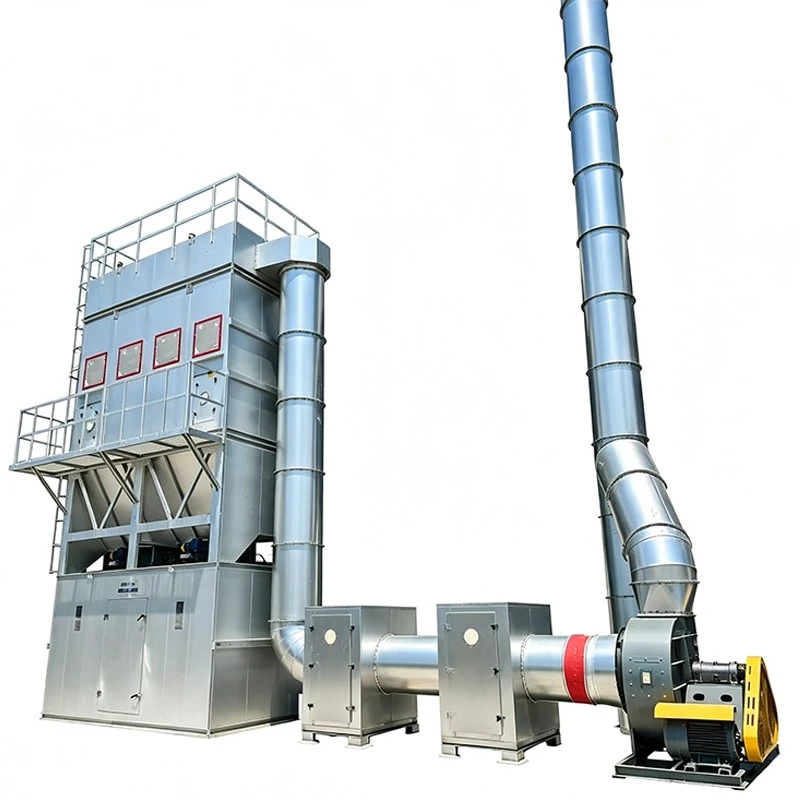
A dust collection system consists of a complete set of equipment designed to capture dust at its source. It utilizes suction hoods placed at dust-generating points and a network of ducts to transport dust-laden gas to a dust collection unit. Inside the unit, gas-solid separation occurs; the dust is collected within the device, while the cleaned gas is routed to a main header or discharged directly into the atmosphere. The dust collector itself is a critical component of this system. From the perspective of ventilation and dust control, dust is defined as small solid particles capable of remaining suspended in the air for extended periods. It forms a dispersed system known as an aerosol, in which air acts as the dispersion medium and the solid particles serve as the dispersed phase. A dust collector is a device designed to separate these small solid particles from the aerosol.
Granular bed dust collectors: These devices use a packed layer of granular material (of varying particle sizes) as the filter medium to trap dust contained in aerosols. They are primarily used at dust emission points in production processes such as those in the building materials and metallurgical industries, often handling flue gases characterized by high dust concentrations, coarse particles, and high temperatures.
Bag-type dust collectors (Fabric filters): These devices utilize woven fabrics or packed fiber layers as the filtration medium. They offer a wide range of applications, configurations, capacities (air volumes), and efficiencies. Primarily used for capturing fine dust, they are employed in both exhaust dust removal systems and intake air systems. In recent years, the continuous development of new filter materials has accelerated advancements in fiber filtration technology; the constant emergence of new products has led to an ever-expanding range of applications.
Electrostatic precipitators: These devices operate by directing a dust-laden gas stream into an electrostatic field. Under the influence of a high-voltage electric field, the gas ionizes to produce electrons and positive ions, which migrate toward the positive and negative electrodes, respectively. As dust particles pass through the active electric field, they acquire a negative charge and migrate at a specific velocity toward the collecting plates (which carry the opposite charge); there, they settle out of the gas stream and are collected within the unit. These precipitators offer high dust removal efficiency, low flow resistance, and ease of maintenance and operation. They are highly effective at capturing fine dust particles, achieving results comparable to those of bag-type dust collectors.