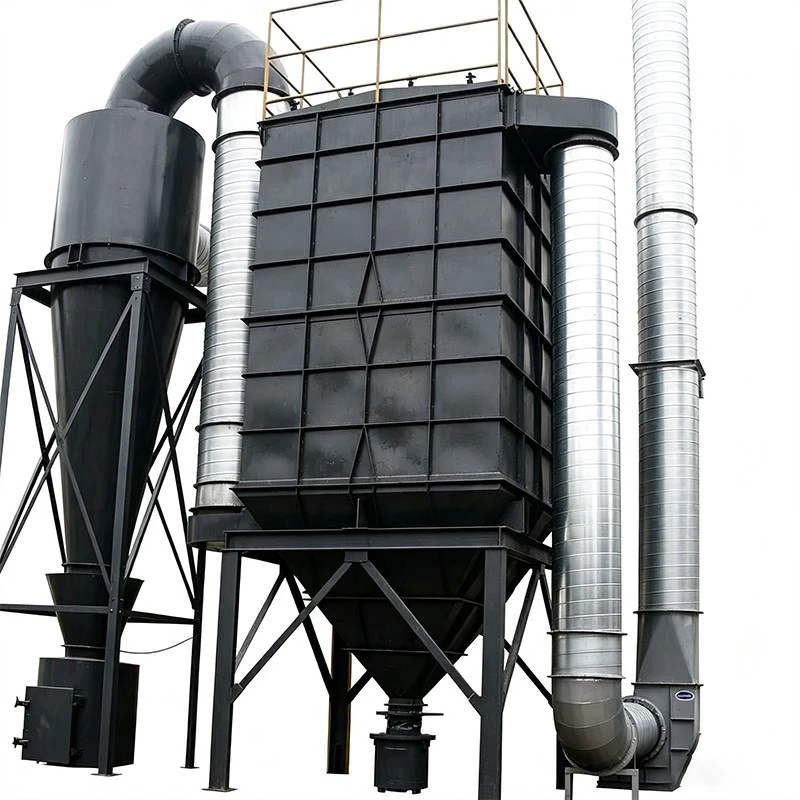
Based on international experience, there are three levels of options for dust collection equipment. The first priority is dust prevention-much like with diseases, prevention is more cost-effective than cure. For instance, installing a chute during material loading/unloading or at conveyor transfer points can significantly reduce the generation and required treatment volume of dust and fumes. When handling bulk materials like steel slag, localized enclosure allows generated dust and fumes to circulate and dissipate their kinetic energy internally, causing the majority of the dust to settle naturally. Internationally, this type of mechanical dust control is known as "passive" (or non-powered) dust collection; it is suitable for the majority of dust in most scenarios and should, at the very least, serve as a pre-treatment step.
The second option involves the supplementary use of water mist or foam for dust suppression. Direct spraying serves two purposes: first, it wets dust particles, causing them to adhere, agglomerate, and grow in size, making them easier to separate from the air. Second, for high-temperature flue gas, direct spraying facilitates evaporative cooling; this allows the gas to cool and shrink in volume using minimal water, while the resulting reduction in gas velocity further aids in dust removal. Older textbooks and design manuals often claimed that spray-based dust suppression was only suitable for particles larger than 50 μm, with an efficiency of merely 40–70%. However, practical experience has shown that advancements in spray technology allow spray systems to remove nearly 100% of dust particles larger than 10 μm and 90–95% of those larger than 1 μm. For example, spray-based systems used during tundish dumping and steel slag processing have achieved actual dust removal efficiencies of 90–95%.
Therefore, from the perspectives of emission reduction, energy conservation, and cost efficiency, passive dust control and direct spray suppression should be prioritized. The third option-ventilation-based dust collection-should only be considered as a last resort. Ventilation systems necessitate energy-intensive fans and dust collectors, making it difficult to save energy or reduce costs. When ventilation systems are required, low-energy electrostatic precipitators should be considered first, with fabric filter (baghouse) collectors considered only as a final option. Reflecting on the actual selection process for dust removal equipment from this perspective reveals areas for improvement. For instance, in applications such as secondary dust removal for converters, blast furnace cast-house dust removal, and loading/unloading dust control, over 80%-or even 90%-of the dust particles exceed 10 μm in size; yet, the vast majority of installations in my country rely on ventilation-based systems using bag filters, which, while effective for emission reduction, entail high operating costs. Similarly, with the converter LT (uncombusted gas) dust removal process, the dust consists largely of coarse particles, but electrostatic precipitators (ESPs) are often designed based on inlet concentrations of 70–100 g/Nm³, resulting in an excessive number of electric fields and bulky equipment. Of course, the issue of inconsistent efficiency in some electrostatic precipitators is another practical problem that must be addressed.