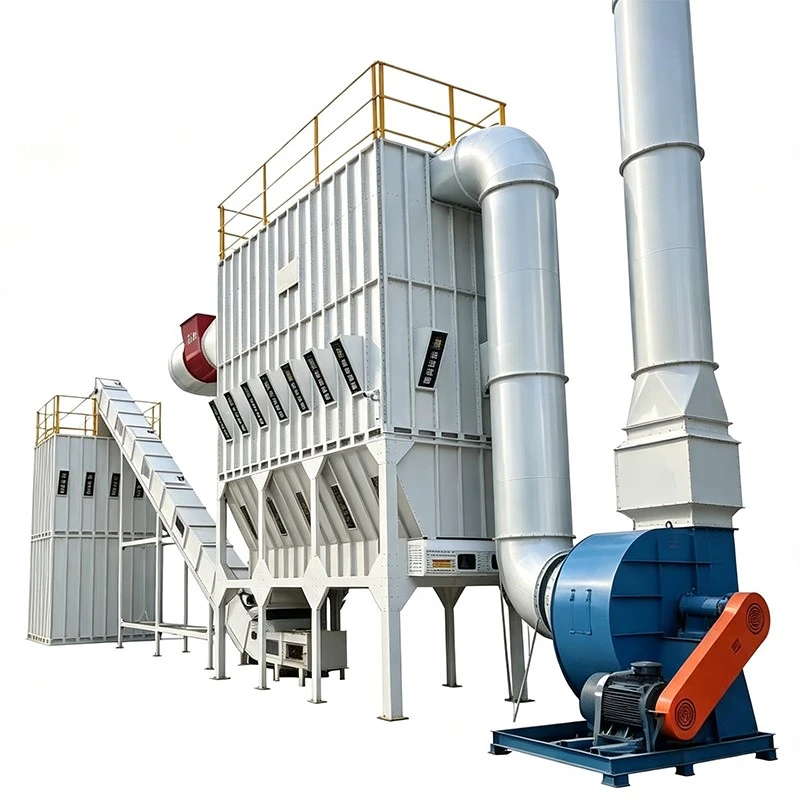
Dust collection equipment refers to industrial devices designed to separate dust from flue gas, primarily utilized in boiler operations and industrial manufacturing. Performance is evaluated based on metrics such as gas handling capacity, pressure drop, and dust removal efficiency. These devices are categorized by their operating principles into five types: mechanical, wet-scrubbing, filtration, electrostatic, and magnetic dust collectors. Among them, the bag-type dust collector is the most widely used due to its high efficiency; it employs natural or synthetic fiber filter bags for internal or external filtration, with system design requiring careful consideration of parameters such as airflow volume, temperature, and dust concentration.
Bag-type dust collectors utilize negative-pressure reverse-blowing technology; a compartmentalized design combined with an induced-draft fan system enables dust removal efficiencies exceeding 98%, making them suitable for small-to-medium-sized industrial boilers. Electrostatic precipitators (ESPs) are powered by high-voltage silicon rectifier units and feature integrated PLC control systems to regulate components such as pulse rappers and heaters. They employ charged spray-cleaning technology to remove accumulated dust from electrodes-a process that allows for adjustable parameters and does not require powering down the unit. Industry standards such as DL/T 514-2004 and JB/T 10341-2002 regulate equipment manufacturing and application, while technologies like low-pressure pulse-jet cleaning and compartmentalized dust removal further enhance operational stability and energy efficiency.