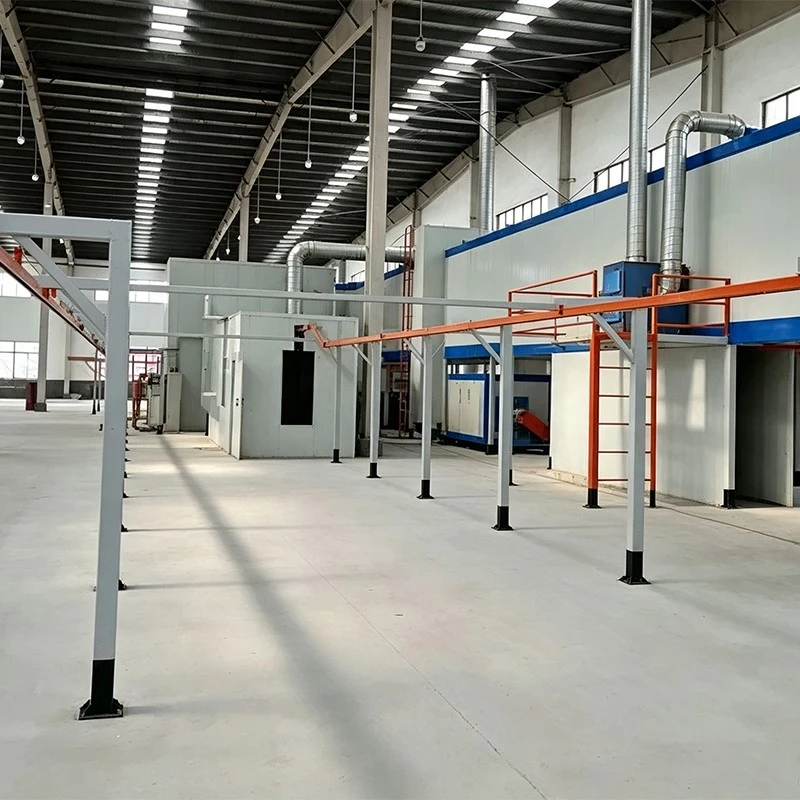
The organizational structure of a coating production line is determined by factors such as production volume, process methods, and workpiece characteristics. Coating production lines generally take the following forms: In continuous-movement lines, workpieces move uninterruptedly through all process stages or stations via a continuously moving conveyor; this type is suitable for small-to-medium workpieces and high-volume assembly-line production. In intermittent-movement lines, workpieces move in stages through the process via an intermittently moving conveyor, remaining stationary during actual processing; this type is primarily used for batch spraying of large-to-medium workpieces.
Reciprocating-movement lines allow workpieces to move back and forth between stations to complete various spraying stages; suitable for almost all product types, this method is ideal for small-batch or single-unit production. Transfer-cart lines use carts to move workpieces to automated spraying equipment and workstations; while suitable for small-batch or single-unit production of large-to-medium workpieces, they have drawbacks: workpieces exit the spray booth after painting and travel via cart to the drying oven, allowing significant solvent vapors to escape into the workshop; the coating film is prone to dust contamination; and the transfer carts require a large floor area.
In stationary coating lines, the entire spraying process takes place at a single workstation; this is suitable for large, bulky, or unwieldy workpieces that are difficult to move, such as containers, tanks, vehicles, and metal structural components. The "pass-through" spraying method for large items targets long workpieces, which are painted while moving through a relatively short spray booth; this approach significantly reduces the size of the spray booth and lowers energy consumption while offering effective ventilation.